
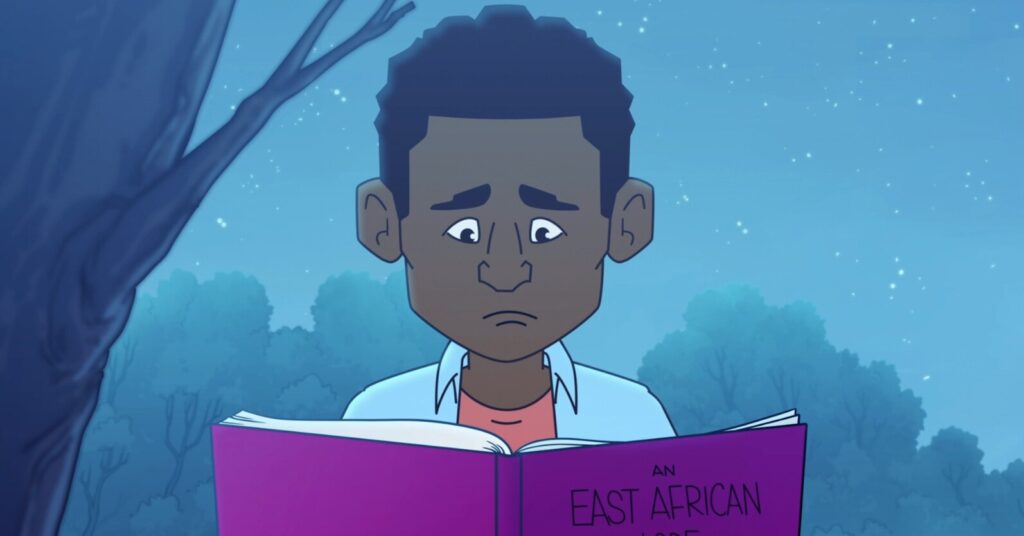
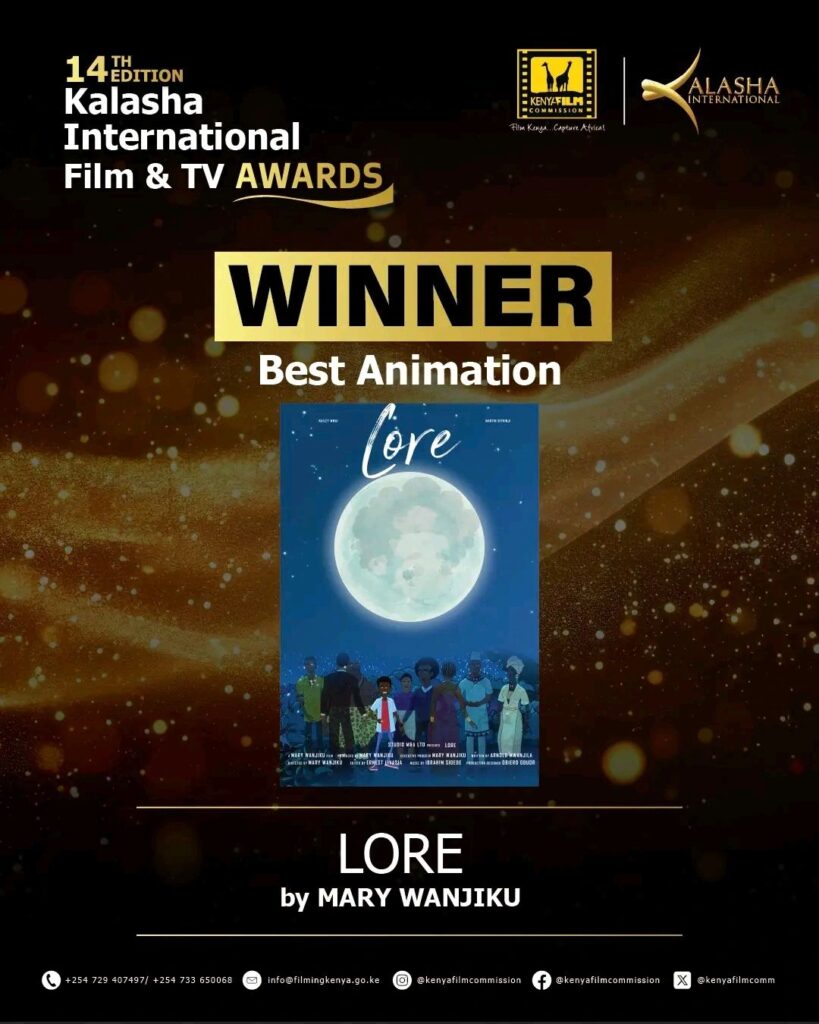
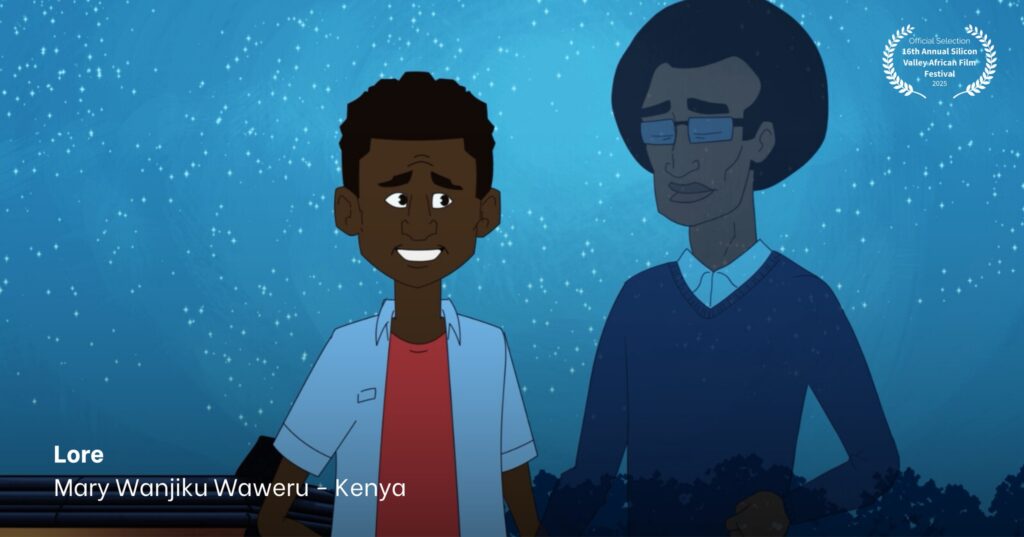
At the 2026 Kalasha Awards, Kenya’s equivalent of the Oscars, Mary Wanjiku’s animated production Lore, a short film about a young boy struggling to come to terms with the untimely death of his father, took home the award for Best Animation Production. On paper, it is a moment worth celebrating: a locally produced animated work recognised on a national stage in an industry where visibility is often hard-won.
Reacting to the win on LinkedIn, Wanjiku wrote:
“ We did it!!! Kalasha Award for Best Animation Production. Still feels a bit unreal typing that. A big thank you to France In Kenya for backing this project from the early stages. That support meant everything.”
The joy is genuine, and the achievement is real. But the gap between the win and the industry that received it tells a more complicated story, one about categories, systems, attention, and whether African animation is being built to last.
A Category That Tells a Story
The Kalasha Awards feature a broad spectrum of categories across film and television; acting, directing, writing, and technical crafts, each reflecting the layered structure of a maturing screen industry. Animation, however, remains confined to a single category: Best Animation Production.
This is not a trivial detail. Awards frameworks are, in many ways, mirrors of industry depth. Where there are multiple categories, there are usually multiple pipelines: feature-length productions, series, short films, student work, and experimental formats. Where there is only one, it often signals consolidation rather than expansion.
To put this in a continental perspective: the Africa Magic Viewers’ Choice Awards (AMVCA), arguably Africa’s most prominent pan-African film and television awards, has not yet introduced a single animation category. A continental awards body with a broad remit across Nollywood, broadcast, and film still does not formally recognise animation. The inference is unavoidable: if a single category at the national level feels like progress, the absence of one at the continental level suggests animation remains structurally invisible at scale.

In this context, animation’s presence at Kalasha feels less like integration and more like inclusion; acknowledged but not yet absorbed into the industry’s structural core. The attribution of Lore to a single creator also underscores a recurring pattern across African animation: the prominence of individual creators over institutional systems. Unlike live-action productions, which are increasingly backed by production houses, financing structures, and distribution partnerships, many animated works across the continent still emerge from tight-knit teams or singular creative leads.
This is not inherently a weakness. Some of the most compelling creative work globally has come from auteur-driven processes. But at an industry level, it raises a critical question: Can a sector scale sustainably if it is powered primarily by individual excellence rather than industrial infrastructure?
One could argue that a single category is appropriate precisely because the Kenyan animation industry is nascent. Creating sub-categories before there is sufficient volume to fill them would risk diluting the award’s credibility or forcing artificial distinctions. There is some merit to this — no one expects a mature animation ecosystem overnight.
However, this framing mistake the symptom as the cause. The reason there is insufficient volume is precisely because the structural conditions for volume, like financing pipelines, training institutions, and distribution channels, have not been deliberately cultivated. A single category at an awards show is not the problem; it is the diagnostic. The industry is not being built to handle more categories, and until it is, the volume argument becomes circular.
Visible Enough to Win, not to be Discussed
Another striking dimension of Lore’s win is the relative quiet that surrounds it. While major live-action winners often generate extended discourse like analyses of narrative themes, cultural significance, and production choices, animated works rarely receive the same depth of engagement. This creates a peculiar imbalance: animation is visible enough to be awarded, but not yet visible enough to dominate conversation. And in an attention economy, conversation is currency.
Our arrival at this observation is not from a single data point, but from close to two years of consistent coverage of African animation ecosystems across multiple countries. The pattern repeats: a win is celebrated, a post goes up, and then the discourse moves on. Meanwhile, live-action productions, even those with smaller budgets, attract panel discussions, think-pieces, and sustained media coverage.
This is not about the quality of the work. It is about the depth of the interpretive infrastructure, the critics, analysts, academics, and platforms that sustain conversation around a medium. Animation in Africa has not yet built that infrastructure. And without it, even wins can feel hollow after the applause fades.
Enter the State: Promise at Scale, Delivery in Question
The presence of William Ruto at the ceremony added another layer to the moment. In his remarks, the Kenyan president pledged KSh 500,000 to each award winner and announced a broader KSh 500 million investment in the country’s creative economy.
On the surface, this signals a significant shift. Government recognition, backed by financial commitment, suggests that the creative sector is being taken seriously at the highest levels of policy. But when viewed through the lens of animation, these announcements introduce a productive tension. Because funding, while essential, does not automatically translate into structure.
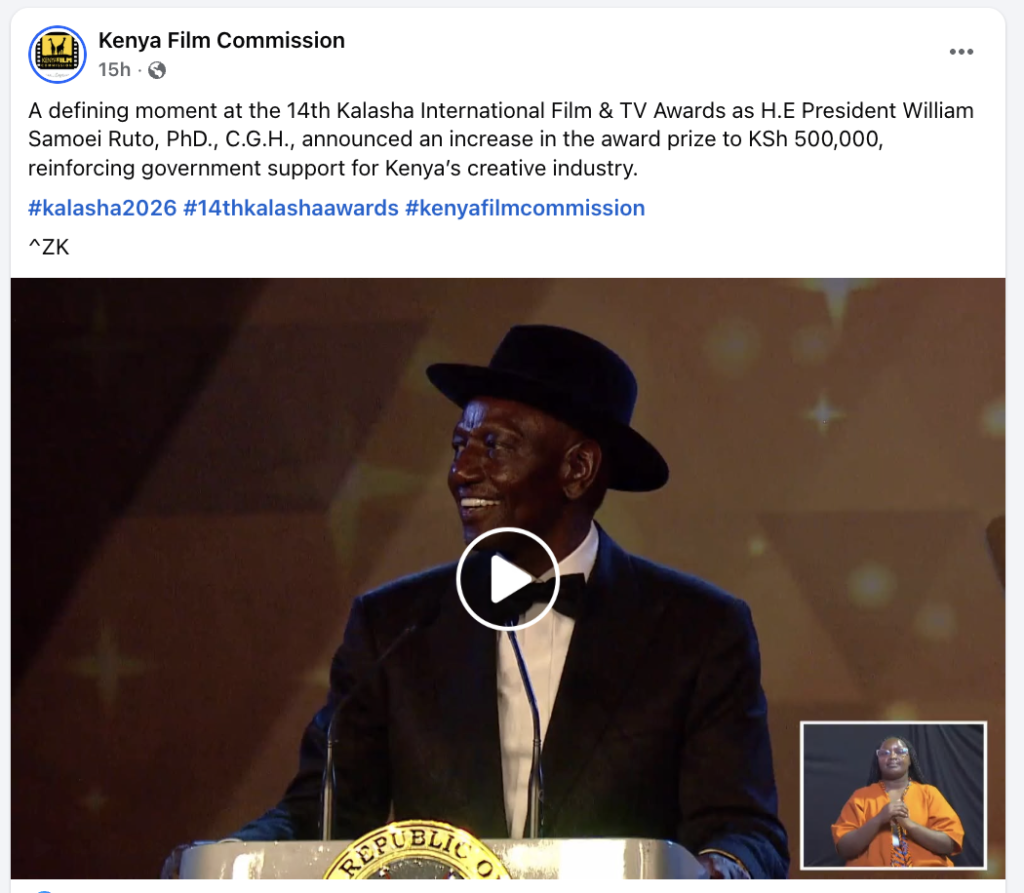
A cash award of KSh 500,000 is meaningful. It can offset production costs, reward effort, and provide short-term relief for creators operating within tight budgets. But it does not, on its own, build animation studios, establish training pipelines, create distribution networks, nor sustain long-term production cycles. In other words, it rewards completion, not continuity.
Similarly, a KSh 500 million commitment to the creative economy is substantial in scale, but its impact will depend entirely on how it is deployed. Without targeted frameworks for animation like grants, incubators, specialised funds, or policy incentives, the sector risks remaining on the periphery of that investment.
This is where the contradiction sharpens: Animation is being recognised, rewarded, and rhetorically supported, but it is still not structurally embedded within the industry.
What makes this moment particularly intriguing is its sequence. In many global markets, industry maturity precedes state intervention. Infrastructure is built, markets expand, and governments step in to amplify or regulate growth. Here, the pattern appears inverted. The Kenyan government is signalling belief in the creative economy at a time when key sectors like animation are still consolidating their foundations. This creates a scenario where policy ambition is outpacing institutional readiness.
We are not downplaying other key creative economy sectors. However, our coverage of the animation space shows that it is simultaneously an opportunity and a risk. This is because early investment could accelerate growth, close gaps, and position the country as a leader in African animation. However, without deliberate structuring, such investment may dissipate across a fragmented ecosystem, reinforcing existing limitations rather than resolving them.
Beyond a Single Win: What Lore Ultimately Represents
To read Lore’s victory purely as a milestone would be to miss its deeper significance. It is a diagnostic signal as much as it is a success story. It tells us that the talent exists, the stories are being told, and the work can compete. But it also reveals that the systems are still thin, the categories are still narrow, and the conversation is still limited. Lore is, in this sense, is a triumph of what is possible within current constraints and a question of what could be achieved if those constraints were systematically addressed.
Beneath the surface of every independent animated success lies a litany of invisible challenges: animators working from personal laptops because studios are too expensive to rent; creators spending more time on grant applications than on actual production; distribution deals that fizzle because streaming platforms still classify African animation as a niche risk; and a generation of talented artists who age out of the industry because the freelance-to-full-time pipeline never materialises. These are not problems that a single award category, or a single cash prize, can solve.
So, beyond the applause, if African animation is to move from recognition to dominance, moments like this must be treated as inflexions, not endpoints. Because awards can spotlight excellence, funding can enable production, but only structure can sustain an industry.
Until that structure emerges across training, financing, production, and distribution, wins like Lore will continue to feel, however deserved, like victories in isolation. And that is the paradox at the heart of this moment: Animation has arrived on the stage, but the industry it belongs to is still being built.
--------------------------------------------------------
--------------------------------------------------------
AI Use at TheACE
TheACE uses artificial intelligence tools to support research, drafting and analysis across Africa’s creative industries. All content is verified, edited and approved by our human editorial team to ensure accuracy, clarity and responsible storytelling. AI assists our work; it does not replace human judgment.