
For generations, comic books have been culturally typecast. They have lived in the realm of folklore, fantasy, ancient legends and caped superheroes. They have entertained, dazzled, and occasionally inspired. But rarely have they been taken seriously as instruments of public health or social policy.
Across parts of Africa, that perception is quietly being dismantled.
In classrooms where menstruation is still whispered about, where girls miss school because they lack sanitary products, and where stigma travels faster than science, comic books are emerging as unlikely but powerful infrastructure. At the centre of this shift is PadHer, a Nigerian-founded social enterprise reframing both menstrual health education and the cultural function of comics themselves.
Founded by Chika Nwaogu, PadHer operates at the intersection of storytelling, behavioural science and practical intervention. It does not approach menstrual health solely as a supply-chain problem, nor merely as an awareness campaign. Instead, it treats stigma as a narrative failure and responds with narrative design.
The Silence That Costs Girls Their Education
Period poverty in Africa is not simply about affordability. It is a compound issue shaped by access, misinformation, cultural taboos and infrastructure gaps. In many communities, girls enter puberty without accurate biological knowledge. Some are unprepared for their first menstruation. Others face teasing, isolation or outright shame in school environments. The result is often absenteeism, diminished confidence and in some cases early dropout.
While global conversations around menstrual equity have intensified, interventions frequently lean on clinical materials or top-down workshops that struggle to penetrate deeply rooted cultural silence. This is the gap PadHer identified.
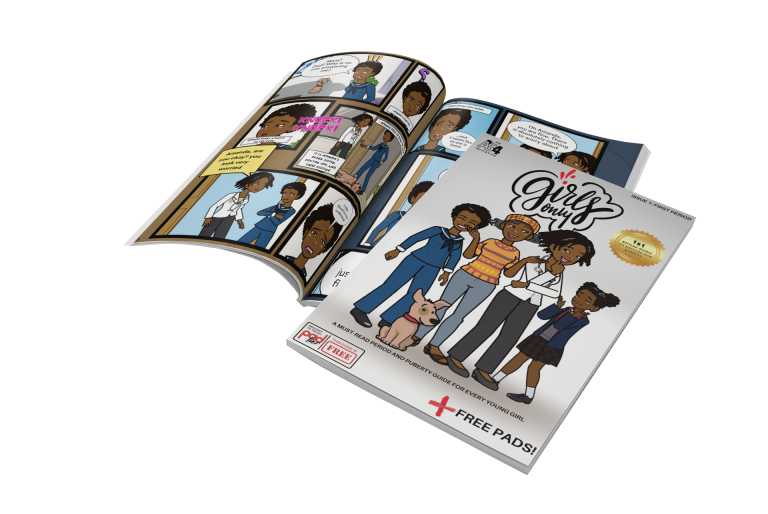
Rather than treating girls as passive recipients of information, the organisation embeds learning inside narrative. Its flagship comic series, Girls Only, follows a young African girl navigating her first period. The story format allows readers to encounter menstruation not as a medical anomaly, but as a shared human experience. Questions are asked openly. Fears are acknowledged. Practical guidance is embedded within dialogue.
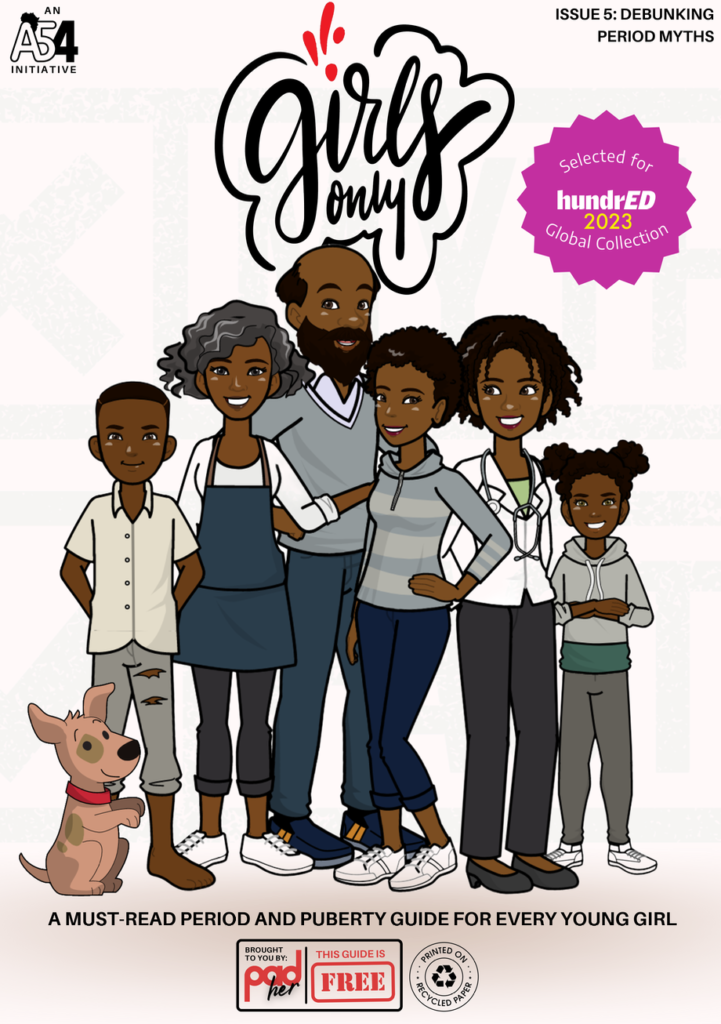
The emotional architecture of the comic is deliberate. Adolescents absorb stories more readily than instructions. Visual storytelling lowers literacy barriers and sustains engagement in ways that pamphlets often cannot. In communities where discussing reproductive health may be culturally sensitive, a comic provides psychological distance. It creates space.
But PadHer’s strategy does not stop at girls.
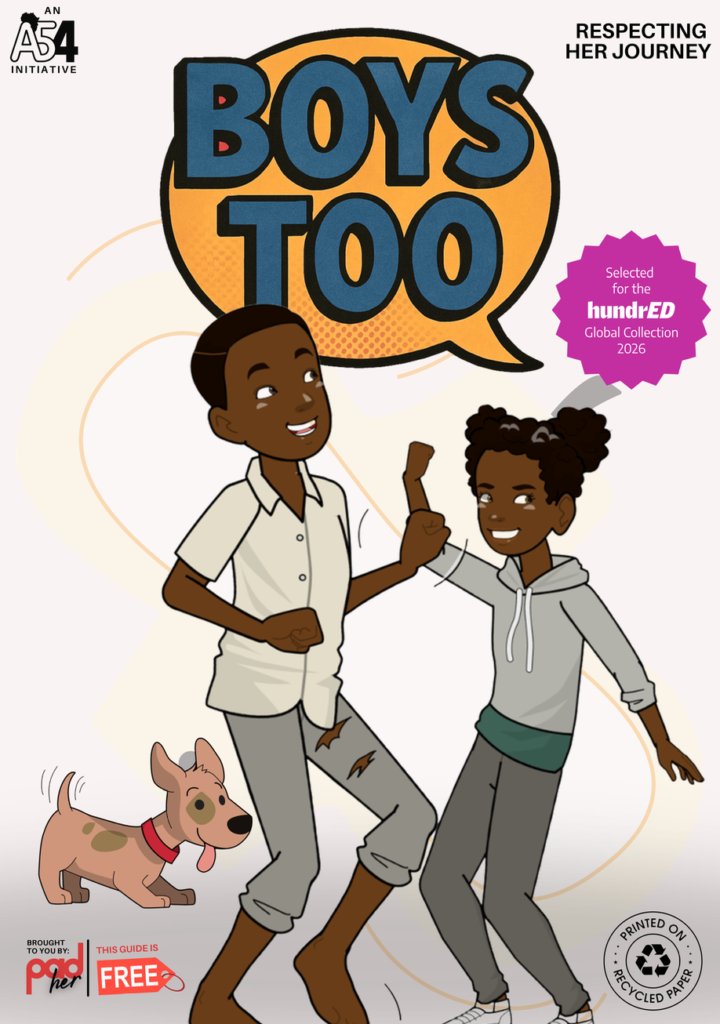
One of its notable publications, Boys Too: Respecting Her Journey, expands the intervention to boys. This is not symbolic inclusion. It is structural strategy. Stigma is frequently reinforced at peer level. When boys are uninformed, teasing and misinformation proliferate. By educating boys about menstrual biology and empathy, PadHer addresses the social ecosystem around girls, not just the girls themselves.
This is where the organisation departs from traditional menstrual health programming. It recognises that dignity is relational.
From Storybook to School System
The impact of this approach is measurable. According to the PadHer 2025 Impact Report, the organisation expanded significantly across communities during the past year, distributing educational comics alongside reusable sanitary products and deepening partnerships with schools and grassroots networks.
The report documents growth in cross-border initiatives, increased workshop implementation, and strengthened community engagement models designed for continuity rather than one-off outreach. PadHer’s programming integrates comic distribution with facilitated sessions, ensuring comprehension and dialogue accompany the materials.
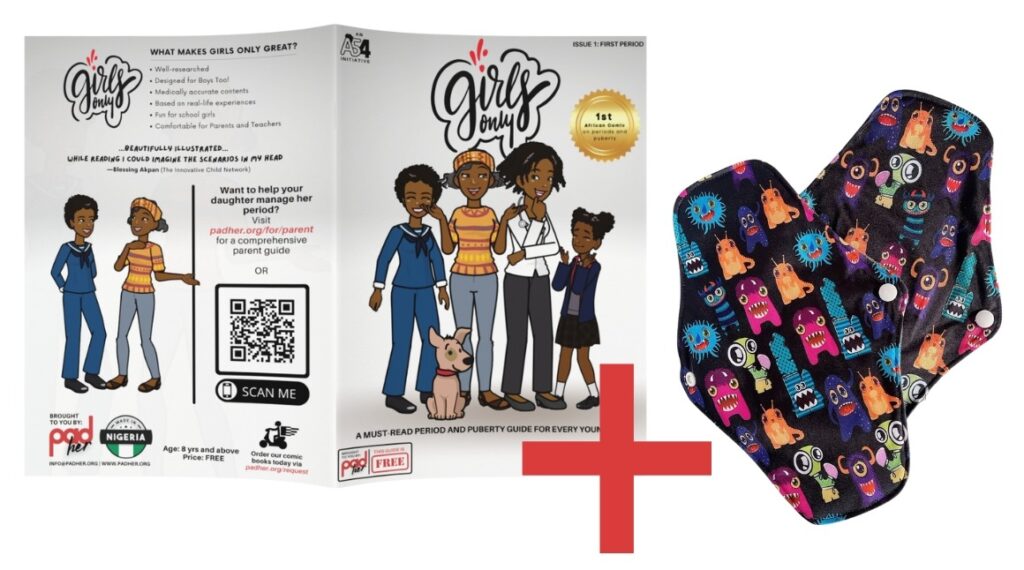
Each comic distribution is paired with reusable sanitary pads, a decision rooted in sustainability. Disposable products can create recurring dependency; reusable kits extend autonomy. The model therefore combines narrative empowerment with tangible access, reducing both informational and material barriers.
The scale of this hybrid approach attracted international attention. In 2025, PadHer secured a $140,000 grant from the Chocolonely Foundation to expand menstrual health education into Ghana’s Volta Region. The funding, reported by BusinessDay, supports broader distribution of comics and reusable sanitary materials to underserved schools.
Beyond funding, PadHer has also received global validation from HundrED, which recognised it among the world’s most impactful and scalable education innovations. Such recognition is reserved for initiatives demonstrating replicable outcomes and evidence-based design.
For a model rooted in comics, a medium frequently dismissed as recreational, that recognition carries symbolic weight.
The Founder’s Pattern of Visibility
Understanding PadHer requires understanding its founder’s professional trajectory. Chika Nwaogu’s career has consistently revolved around access and visibility. Before entering the menstrual health space, he co-founded Publiseer, a digital distribution platform that enabled African authors and musicians to monetise their work globally. He later launched Savvy, a global startup development programme supporting entrepreneurs across emerging markets.
In each case, the underlying thesis was similar: talent and potential often abound, but structural barriers prevent visibility and monetisation. With PadHer, the barrier was not creative visibility but biological silence.

Menstruation is universal, yet discussion around it remains constrained in many communities. Nwaogu’s pivot into menstrual health education was less a departure from his earlier ventures than an extension of his long-standing interest in unlocking suppressed narratives.
The decision to use comics as the delivery vehicle reflects that continuity. Comics are accessible, portable, emotionally resonant and culturally adaptable. They can travel across language boundaries more fluidly than dense text. PadHer’s materials are available in multiple African languages, ensuring that linguistic diversity does not become another barrier to comprehension.
The choice also challenges hierarchy in educational materials. By elevating comics into legitimate pedagogical tools, PadHer subtly contests assumptions about what “serious” education looks like.
Designing for Sustainability, Not Sympathy
PadHer operates as a social enterprise rather than a purely donation-dependent nonprofit. This distinction matters. Its hybrid revenue model reinvests earnings into programme expansion, reducing vulnerability to fluctuating grant cycles. The Chocolonely Foundation grant accelerated regional scaling, but the organisation’s design does not rely exclusively on philanthropic infusion.
Sustainability in menstrual health programming is often overlooked. One-off pad distributions, while impactful in the short term, can create supply gaps once funding ceases. PadHer’s reusable product integration and school-based engagement model aim to embed continuity within communities.
The 2025 Impact Report reflects this shift from episodic outreach to system-oriented programming. Growth metrics are paired with partnership development, reinforcing the organisation’s intent to institutionalise menstrual education within school environments. This orientation positions PadHer not simply as a charity, but as a structural actor within educational ecosystems.
Reclaiming the Cultural Function of Comics
The broader implication of PadHer’s work extends beyond menstrual health. It interrogates the cultural boundaries placed around comics. Historically, comics in Africa have been associated with mythology, political satire or superhero archetypes. While those genres remain vital, they have inadvertently reinforced the notion that comics are primarily entertainment vehicles.
PadHer disrupts that framing.
By embedding public health education inside illustrated storytelling, it demonstrates that comics can function as civic tools. They can transmit biological literacy. They can shift behavioural norms. They can deconstruct stigma in ways that formal lectures often cannot.
This reframing has implications for educational policy and creative industries alike. If comics can effectively address menstrual health, they can potentially support literacy campaigns, climate education, civic awareness and financial literacy initiatives. The medium’s perceived informality becomes an advantage rather than a limitation. In a continent with one of the world’s youngest populations, formats that resonate with youth culture carry potency.
International Women’s Day Beyond Symbolism
Publishing this feature in March, the month of International Women’s Day, invites reflection on how empowerment is operationalised. Social media campaigns and corporate slogans often dominate the season. Yet the lived realities of girls navigating puberty without support remain underrepresented in mainstream discourse.
PadHer’s intervention offers a grounded counterpoint to abstract empowerment rhetoric. When a girl understands menstruation before her first period, fear diminishes. When she has access to reusable sanitary products, attendance stabilises. When her male classmates are educated alongside her, stigma recedes. These are incremental shifts, but cumulative in effect.

The absence of capes and mythology in PadHer’s comics does not diminish their heroism. It redefines it. The transformation here is not cinematic; it is cultural. It occurs in classroom conversations, in reduced absenteeism, in boys choosing empathy over mockery.
In reengineering how menstruation is discussed, PadHer also reengineers how comics are perceived. It positions them not at the margins of education, but within its architecture.
As Africa’s creative industries continue to evolve and as conversations around gender equity deepen, PadHer stands as a case study in cross-sector innovation. It demonstrates that storytelling is not peripheral to development work. It is central to it. Comic books, once confined to the realms of fantasy and folklore, are now carrying a different narrative, one rooted in biology, dignity and structural change.
No capes required.